Friday, 11 November 2016

Thursday, 12 March 2009
Meanwhile, back in the real world of blogging ...

Where to begin?
There is a hint in the rather surreal cartoon above. We lost our telephone wires in the big storm in January, and that took ten days to get restored. Then, because the repair was temporary, and the wires sagged lower than usual, a local farmer drove through them with a large and tall agricultural machine.
OK, so call the provider from a friend's phone and get it sorted, right? Um, no. Actually, this could have been funny.
Our provider is Alice, part of Tiscalli. They buy capacity from France Telecom and flog services on as an independent. You probably know the kind of thing. Part of their contract with France Telecom is that they take over the maintenance of the line, by, err, paying France Telecom to fix it when it goes wrong. But they have to call in FT. You can't do that; you can only deal with Alice.
Well, first the funny part (this all takes place in French of course):
"Hello Alice, there is a problem with the line - it's broken"
"OK, are you standing by your modem?"
"Err, not exactly, I'm 6 km away, calling from a friend's house, because our line is down"
"Yes, but I can't help you unless you are standing by your modem and reboot it and tell me which lights are on"
"No, I don't think you quite understand, I've seen the line, it's on the ground, and it is in two halves"
"Are you standing by your modem yet?"
"Just a sec, yes, OK, I'm standing by my modem". I think, dear reader, you will grasp that this lie was necessary to move on.
"Good, OK, switch it off and on and tell me what you see"
"I see an error light, because the line is on the ground and broken in two"
... Now I have to tell you that this pantomime went on for ten times longer than I depict it. In the end, after divine intervention, the baton was passed to someone in technical who, after more of the above (I swear it), did a remote test and declared "Oh, your line seems to be broken".
Hooray! They agreed that it would be fixed that week (this was Monday evening).
It was not. More calls. Apparently someone from Alice had been to inspect the site and had declared that the line was down and in two pieces (I though that we had told them that ...).
So what next?
Ah, well according to their service agreement with FT, the line would be fixed before the end of week 2.
Except it was not. (In brackets, hello, is this a first world country or what?)
Further calls to Alice became more and more weird. Their computers were down, our account was blocked, no sorry, it and a number of others were subject to some review which means that they could not be serviced for a while. How long? Well, a while. Etc etc etc.
Now you need to think about this for a bit (I know I have). Ninety nine times out of 100, Alice doesn't need to lift a finger. If a line goes wrong, it will affect FT customers too, so they will have to come in and fix it at their own expense.
But we fall into the 1% (or 0.1%) of cases where the line comes to us, alone. Or at least the last kilometer or two - a small section is shown below as it marches towards chez nous.

And I slowly began to realise that they weren't going to fix our line. Not now, not ever. They were simply, and cynically, waiting until we got so pissed off that we would leave them and rejoin FT, who could then fix the line at their own expense.
I have to say that the realisation stunned me, but I'm convinced I'm right. There is still a 1/2 kilometer of damage from the storm and it will cost hundreds to put right. Or about the revenue from 3 or 4 years of our contract with Alice.
We were in the shit and they were happy to leave us there. Call FT? Tried - "Sorry, you have to take that up with Alice".
So I got an extremely long ladder, put on a fluorescent jacket, climbed up the effing pole (we're talking 4-5 meters here), joined the two ends of the cable using household connectors, went back to the house, fired up the modem, and had working telephone and internet.
Since we still had no word from Alice a week later, we called out of sheer curiosity. Well, they said, the line is working so one of our technicians must have fixed it. Any details of the above on our computer file? Well, no, but clearly it had been fixed, so our problem was ...?
How about the 1/2 kilometer of line that is still trailing along the ground? You want it raised? Fine we'll raise it, but at your expense.
Well, thanks a bunch Alice, and may you all rot in hell, and with no internet to make your punishment even harsher.
So there we are.
I guess that we will simply have to change to FT and after a decent interval tell them that, surprise surprise, our line is on the ground and please come and fix it.
Footnote.
Blogging is a habit, I've realised, albeit a nice one. It has been really quite difficult to return to it after such a break. But I'm sure I'll get back into the swing of things. Anyway, lots of nice catching up on all your lovely blogs to look forward to.
Sunday, 15 February 2009
Broken Britain
A journalist's catchphrase, and not the economic crisis this time but a depressing if familiar story about teenage pregnancy.

The dad is 13-year-old Alfie Patten, and the mother is his 15-year-old 'girlfriend', Chantelle Stedman. Or alleged dad, since two other lads have now come forward saying that they too have had intercourse with Chantelle - who was just 14 when she became pregnant.
The part that depressed me most is not the particular case - it is unusual only in that Alfie is so young - but that lack of critical thinking in our politicians and those who craft our social policies.
Let me digress ever so slightly to mention Signal Detection Theory by Tanner and Swets, which was the product of research done at Bell Labs in the 50s. They looked at the problem of detecting a weak signal in the presence of noise and they reached an important conclusion. If you wanted to detect most of the signals, you would also generate a lot of false alarms. If you wanted to avoid false alarms, you would miss many signals. It's a law of nature and you can't avoid its consequences.
So consider social policy. If you will put up with a lot of discomfort (moral, social, financial) around teenage pregnancy, you would have few of them. If you protect those teenagers from the consequences of their pregnancies, you will have more of them.
If you are willing to allow unemployment to be unpleasant, you will have more people willing to work. If you cushion unemployment, you will end up with more people out of work.
Now don't get me wrong. I don't like people to suffer, not at all. But what I don't like is policies crafted without both sides of this equation being looked at. And it's not even that the policies we do have prevent suffering. Both families are completely dysfunctional. Alfie's dad seems to have had nine children, every one I believe by different partners. Chantelle's family seems to have condoned the two of them sleeping together. And now we have a new poor innocent entry into the dysfunctional stakes. This child is not going to have a good life. For a start, I wouldn't leave her alone in a room with her father for five minutes.
Matt Dunkley, director of children's services at East Sussex County Council, said: "Any birth to parents this young is a cause of great concern to us and in these circumstances we will always offer substantial support to the families involved". Well, that's nice of course, but let's just rephrase that as "We will make sure that the individuals concerned and shielded from the consequences of their behaviour".
There have been the usual bleatings about sex education. Frankly that has nothing to do with it. When I was that age we had virtually none, but we also had no intercourse and no pregnancy.
And shame, regret, remourse, guilt ....?
Not a dot as far as one can tell. It's a pity. I don't know where the idea has sprung from that guilt is a bad thing. It is the surest sign that you do actually have a superego and that you have a modicum of maturity.
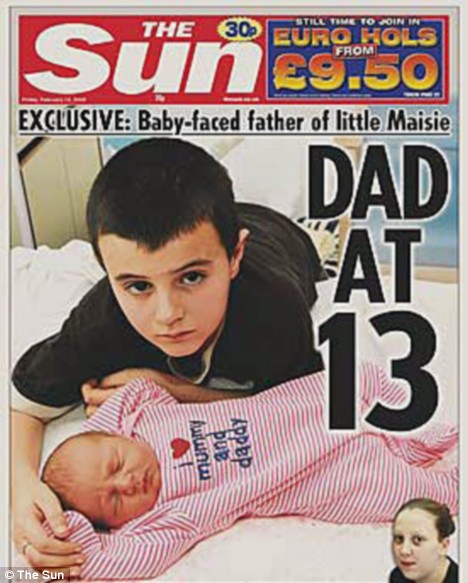
The dad is 13-year-old Alfie Patten, and the mother is his 15-year-old 'girlfriend', Chantelle Stedman. Or alleged dad, since two other lads have now come forward saying that they too have had intercourse with Chantelle - who was just 14 when she became pregnant.
The part that depressed me most is not the particular case - it is unusual only in that Alfie is so young - but that lack of critical thinking in our politicians and those who craft our social policies.
Let me digress ever so slightly to mention Signal Detection Theory by Tanner and Swets, which was the product of research done at Bell Labs in the 50s. They looked at the problem of detecting a weak signal in the presence of noise and they reached an important conclusion. If you wanted to detect most of the signals, you would also generate a lot of false alarms. If you wanted to avoid false alarms, you would miss many signals. It's a law of nature and you can't avoid its consequences.
So consider social policy. If you will put up with a lot of discomfort (moral, social, financial) around teenage pregnancy, you would have few of them. If you protect those teenagers from the consequences of their pregnancies, you will have more of them.
If you are willing to allow unemployment to be unpleasant, you will have more people willing to work. If you cushion unemployment, you will end up with more people out of work.
Now don't get me wrong. I don't like people to suffer, not at all. But what I don't like is policies crafted without both sides of this equation being looked at. And it's not even that the policies we do have prevent suffering. Both families are completely dysfunctional. Alfie's dad seems to have had nine children, every one I believe by different partners. Chantelle's family seems to have condoned the two of them sleeping together. And now we have a new poor innocent entry into the dysfunctional stakes. This child is not going to have a good life. For a start, I wouldn't leave her alone in a room with her father for five minutes.
Matt Dunkley, director of children's services at East Sussex County Council, said: "Any birth to parents this young is a cause of great concern to us and in these circumstances we will always offer substantial support to the families involved". Well, that's nice of course, but let's just rephrase that as "We will make sure that the individuals concerned and shielded from the consequences of their behaviour".
There have been the usual bleatings about sex education. Frankly that has nothing to do with it. When I was that age we had virtually none, but we also had no intercourse and no pregnancy.
And shame, regret, remourse, guilt ....?
Not a dot as far as one can tell. It's a pity. I don't know where the idea has sprung from that guilt is a bad thing. It is the surest sign that you do actually have a superego and that you have a modicum of maturity.
Saturday, 7 February 2009
Living on the edge
Living on the edge ... something we all do every day it seems, whether we realise it or not.
We had a severe storm in SW France recently - high winds which did a lot of damage. Hundreds of thousands of homes were without (a) electricity and hence (b) water, since the pump stations could not function and (c) telephone, so no access to the god Google.
Everything stopped, and it made me wonder just how small the calamity would have to be to wipe much of mankind off the map.
How many days supply of food and water is there in a city like Paris? (Or London, New York or Calcutta). Two days? Three? Five? How long would it take for crazed millions to start pouring out of those cities and into the countryside?
And paradoxically, though I guess obviously, the less technology you have, the less you are affected.
For example, no electricity means no heat for most people, since the electronics and pumps in heating systems stop working. However, for us, heat means a wood-burning stove, so it was business as usual.

It's a bit limited, but we can use the top of the same stove as a cooking hob.
Water pressure started to drop almost immediately after the storm, as water towers began to empty. It wasn't long before we needed to collect and drink water from our "source", a spring that is in a cave directly under our house.

Therefore we were luckier than many. However, no running water means no flushing toilets, no baths and no showers, and it wasn't many days before I would have parted with a large denomination banknote in exchange for a soak and a hair-wash.
Anyway, services were restored in a few days, except for our comprehensively thrashed telephone line - got that back in 10 days. I like the pragmatism of the telephone engineers. There's about half a kilometer of line down (three or four separate trees came down on it), but they've repaired the break on the line as it lies there, forlornly, and will string it up later when they have more time.
So there you have it. Our predecessors, who have lived here since the 12th century, would have noticed little different after the storm, apart from a few trees down. For us modern types, life suddenly became a whole lot more challenging.
It does not bode well, methinks.
On a more cheerful note, no heat, light or computer = heading off to the Pyrenees for a few day's skiing. Nothing remarkable about that, except for the charming honesty of rural France. We stayed in a tiny hotel for two nights, car parked on the street outside with five pairs of skis on top (just held by those elastic things) and not a worry in the world that they might disappear.

Wednesday, 14 January 2009
Profiting from the misery of others

George Soros
My wife was visiting friends in the UK recently. Mary, an active investor, asked how my investing was going (we've swapped info and opinion on stocks going back to before the dot com thing). My wife replied that these days I was mostly trading currencies. At which point Roger, the husband, launched into a tirade pretty well blaming me, and if not me, then others like me, for global financial misery, and damned me for profiting from the same.
Wow. Well I was quite flattered really. I was also surprised by his ignorance (I know the man has a PhD, but that doesn't mean he's stupid).
I wondered how many people think like him, so I decided to flesh the thing out a little in case (a) you think as he does or (b) you are vaguely interested.
The first thing to grasp is that you don't just buy or sell pounds. Currencies are always traded in pairs. If you "sell" the pound, you are buying dollars, or yen, or another currency.
But you have already done this when you go on holiday. If you go to the States, you may think you are exchanging your money, but you are actually selling pounds and buying dollars. And vice versa, if you have any dosh left at the end of your holiday.
In a way, all transactions are based on pairs. The shirt manufacturer is selling shirts and buying pounds, exactly the inverse of the M&S buyer, who is selling pounds and buying shirts.
Which brings me round to reciprocity. There are always two sides to the transaction. It's not as if you somehow sell your dollars into a big dollar warehouse somewhere. When you sell dollars (and buy pounds) someone around the globe has just bought your dollars and sold you their pounds.
So where do evil speculators come in? It's hard to see. From the above you will understand that I can't just "dump" pounds. Someone, somewhere, will be buying them with exactly the same enthusiasm as I am selling them. Reciprocity.
Sure, if there are lots of pounds because Gordon is running the printing presses day and night, or folks think that UK plc is stuffed, then someone won't want to give up their dollars for them quite so readily, and can only be persuaded to do so if you chuck in a few extra quid. And in this way the pound falls against the dollar.
Am I an evil speculator? Well I try and anticipate the direction of a move. If I believe that the pound will lose value against the dollar, I will sell pounds (and buy dollars) and later buy back those pounds using fewer dollars and keep the difference -- but only if I'm right. Otherwise, it is I, the evil speculator, who will have to buy back those pounds for more dollars than I originally got for them, and I lose! (And my opposite number wins). It's a zero sum game.
M&S does exactly the same thing. If the price of shirts moves against them, when they come to buy pounds by selling shirts, they will get fewer pounds than they may have parted with originally. They lose.
But can speculators move markets? Not really. About $4 trillion is traded daily around the globe. That's a lot of money. Consider that the war in Iraq has "only" cost half a trillion so far ... So no individual or organisation short of a government could swing a forex market. And even governments can't as John Major found to his cost: Black Wednesday, 1992.
They were frantically buying pounds and selling foreign exchange to prop up the "value" of the pound. George Soros was happily selling them pounds and buying their foreign exchange - he was simply the other side of the zero-sum game. The government got very cross with Soros, but in effect handed him a $1 billion profit. The overall loss to the UK was about $6 billion
If they were really smart they would have sold the pound too. History shows that they could then have bought it back later at a cheaper rate and the billions in profit would have come back to the hard-pressed UK taxpayer.
No, I'm not taking the piss, I mean it.
Wednesday, 7 January 2009
Men behaving fondly
 It's that time of year, well a bit past it, when we celebrate the seeing out of the old and in with the new. We went around to be with french friends. They do know how to party. It takes a lot to get me dancing, which is just as well.
As the last minutes ticked down to midnight there was a fair amount of joshing by the blokes, rubbing each others' faces and muttering about piqué from badly shaved cheeks. The clock struck and everyone kissed everyone. With 15 people I guess that makes it 210 embraces in all.
Now I know I have blogged about (the) french kissing elsewhere, nevertheless I must reiterate that
(a) I find kissing other men strange; however
(b) I find kissing other men strangely pleasant
It is so warm and affirming to have full contact rough cheek-to-cheek smacking kisses with your chums (none of your effete Parisian air-kissing mwahs down here in the Dordogne). And all without affectation or selfconsciousness.
We don't do this often, bloke to bloke (New Year's eve, winning or losing at rugby, funerals, close family etc) but it is a very good way of bonding and something that more reserved cultures have lost to their cost.
[Added later - good gried, that was a bit of a Freudian slip. I wrote "And all without affection or selfconsciousness". I meant of course affectation - affection is definitely allowed].
Friday, 19 December 2008
I mean, how likely is that?
 What with Christmas coming up, and trying to get bedrooms and bathrooms finished for the daughters, there has not been much time for blogging. So here is a pretty silly post.
This goes back to my undergraduate days (how nice to know I wasn't wasting my time, or those scraps of intelligence assigned to me).
It concerns two sentences that say the same thing, but both using completely different words. They are also both alliterative. Which prompts my "How likely is that?". Can anyone come up with two others??
Excuse the language; faint hearted readers may wish to look away.
"Fucked by the filthy finger of fate"
"Doodled by the dirty digit of destiny"
And you can look back now.
Two other snippets concern graffiti in the toilets at University College London. Someone wrote this:
"Being an anarchist means you can spel any way you like".
A day or two later someone, rather wittily in my opinion, added:
"OK, let's start with anarchshit then".
The other bit of graffiti that I thought was pretty good was a scribble above the toilet roll holder, with a sign pointing down. "Sociology degrees - please help yourself".
Well, I was a psychology postgraduate, so I was clearly prejudiced.
Anyway, have a really good break and a happy Christmas or whatever else you would like to celebrate.
Friday, 5 December 2008
Hawks and Doves
 This post is written with the previous post, on crime and punishment, in mind. There were many interesting comments which ranged from "and eye for an eye" through to education of the criminals, and then the need to understand bad behaviour with a view to preventing it in the first place.
This got me thinking. As a preamble, let me pose a question; one that exercises me from time to time. It is this: "Why do the wicked prosper?"
OK, maybe that's put a bit baldly, but in more general terms, why, when most of us are good and cooperative, do some people take advantage, hoodwink, steal, assault? Why do we find that a consistent fraction of the population are psychopathic; the real "undead" who walk among us?
[Psychopaths should not be confused with psychotics. The latter are insane, while the former lack any conscience and have a profound lack of empathy. They use other people for their own ends, and are the ones who can torture and kill without qualm. They constitute 1% or 2% of the population, and good at masking what they are.]
And to answer my own question, could it be that (just as virtue does) wickedness brings its own rewards?
 Let's fast forward to Hawks and Doves, a simulation first devised by the biologist John Maynard-Smith in 1973, and which is based on Game Theory. Simple though the rules are, I think it has something to tell us about social conflict.
Though the simulation is called Hawks and Doves, you can't tell from looking at the participants what they are - just as in real life a thief or a psychopath looks like you or me. The name derives from their aggressive or non-aggressive behaviour.
How does it work. Well imagine a population of Doves. Maybe a bit like the 12 disciples, but multiplied up a bit. Every now and then two of these Doves will compete over a resource, but since they won't fight the chances of either winning is 50:50, and they never have to bear the cost of injury.
Now add to this mix a mutation. We have our first Hawk, someone who is quite prepared to fight over a resource. What happens? Well, sad but true, it's a bit of a no-brainer; the bugger wins all the time, since no Dove will actually fight. Plus he never bears the cost of injury. So he is very successful.
Now what, in biological terms, does this mean? It means that he reproduces like crazy and pretty soon we see a lot more Hawks in the population. That doesn't mean they take over the world though.
As the proportion of Hawks increases so the probability of a Hawk meeting a Hawk becomes greater and greater. Now there will be a fight. Sure, each Hawk in a Hawk-Hawk conflict will win half the time on average, just as a Dove does in a Dove-Dove conflict. However the Hawk now has a cost that no Dove has: injury.
So there you have it, all the elements for a simulation (there is one other element, posturing, which carries a cost too, but it doesn't add much to this discussion).
- the reward value of the resource
- the cost of injury
- the proportion of Hawks and Doves and how this evolves
The mathematics behind the simulation is not complicated and for given costs and rewards, which you can manipulate, the population will stabilise at a given proportion of Hawks and Doves.
What I find thought provoking about the simulation is that wickedness does not need an explanation. Or rather, the explanation is that bad behaviour exists, not because baddies are ignorant or poorly educated, but because being bad is actually quite a successful strategy. In fact, the thing that holds the proportion of baddies down is simply the cost of injury (which you could treat symbolically as a fine or time in the stocks or behind bars).
But you always find baddies. Every time the simulation is run, the outcome is the same. Turning the other cheek, is, alas, not a philosophical gesture to a baddie, it is just an injury-free reward.
Are the rules too simple to apply to real life? Perhaps. Which is not to say that there are no lessons to be learnt. And complex behaviour can spring from very simple rules as John Horton Conway showed with his now famous Game of Life.
The following may or may not be true, but they follow from the above:
- badness is not an aberration; it exists because it is a viable strategy
- like the poor, it will always be with us
- but you can lessen its incidence by increasing the cost of injury or its symbolic equivalence
Sunday, 30 November 2008
Crime and punishment
I don't have much sympathy for Islamic Sharia law, but a recent case has me thinking again.
The setting is Iran, and it concerns a young woman who had spurned the approaches of a man. His response was to throw acid in her face which has left her disfigured and blind. You can read about it here.
Under the Sharia code of qias or equivalence the victim can ask that the guilty party be punished in a like manner. The court accepted her plea and the man has been sentenced to be blinded by acid, though I don't believe that the punishment has yet been carried out.
This seems barbaric, but then so was the attack, and it is far too common in the middle east and asia. The acid is usually battery acid, and thus very easy to get hold of, and it is not the sort of attack you can carry out without premeditation.
These are the kinds of injury that commonly occur. The photograph is of a different woman, injured by her husband after they were divorced.

Other recent attacks have been on schoolgirls in Afghanistan, whose only crime is that they want to go to school.
In the West we would argue that violence is an inappropriate response to violence, or that such punishment reduces the state to the level of the criminal. But should we be liberal and intellectual about such crimes? These men are absolute bastards. Is there an argument for an eye for an eye?
Saturday, 15 November 2008
Warning! Falling pounds. Hard hats must be worn
For anyone who lives in the UK or who still has pounds (me, alas), the money markets have an interesting message right now. The pound is shite. Gordon and his friends are busy screwing it, big time. Well, no surprise there. When you force the tax payer to become a shareholder in failing businesses, and buy up dodgy assets in the process of recapitalising careless banks, then something's gotta give. And it is the currency.

Now you may have a poor image of the forex market. But you have to respect its lack of sentiment. If you start printing money, and generally piss on the economy, the speculators (and the serious dealers too) will dump your currency like last night's bad curry. You don't have to like the markets to recognise they are always right. Seriously.
OK, so let's cut to the chase. This is what the pound looks like against the dollar. Down means the pound is falling relative to the dollar.

Those brave enough might like to click for a larger view.
Now on the face of it, this is quite a strange outcome. I mean, what with the USA being the home of subprime and all that, why is it our currency that's f*cked and not theirs? Well, right now folks want out of equities and pretty well every other damned thing, and want to hold cash. And the cash they want to hold is the good old greenback. So its price is high.
But hold on. That's not the whole story, and not enough of an excuse for Gordon. Look at how the pound is doing against the euro. Up, in this case, means the euro is doing well and the pound is doing badly.

And as you can see, the pound is pants against the euro.
When your government tells you they are doing what it takes, be afraid. Be very afraid.

Now you may have a poor image of the forex market. But you have to respect its lack of sentiment. If you start printing money, and generally piss on the economy, the speculators (and the serious dealers too) will dump your currency like last night's bad curry. You don't have to like the markets to recognise they are always right. Seriously.
OK, so let's cut to the chase. This is what the pound looks like against the dollar. Down means the pound is falling relative to the dollar.

Those brave enough might like to click for a larger view.
Now on the face of it, this is quite a strange outcome. I mean, what with the USA being the home of subprime and all that, why is it our currency that's f*cked and not theirs? Well, right now folks want out of equities and pretty well every other damned thing, and want to hold cash. And the cash they want to hold is the good old greenback. So its price is high.
But hold on. That's not the whole story, and not enough of an excuse for Gordon. Look at how the pound is doing against the euro. Up, in this case, means the euro is doing well and the pound is doing badly.

And as you can see, the pound is pants against the euro.
When your government tells you they are doing what it takes, be afraid. Be very afraid.
Tuesday, 11 November 2008
Fairies at work
Two wonderful "fairy rings" of mushrooms have appeared in our meadow. Here is a picture of one of them, with oval added by me to illustrate the regularity of the growth.

While they are a natural feature of mushroom growth, there is still uncertainty about exactly how they come about.
They bring with them a rich tapestry folk-lore. From Wiki:
A great deal of folklore surrounds fairy rings. Their names in European languages often allude to supernatural origins; they are known as ronds de sorciers ("sorcerers' rings") in France, and hexenringe ("witches' rings") in German. In German tradition, fairy rings were thought to mark the site of witches' dancing on Walpurgis Night, and Dutch superstition claimed that the circles show where the Devil set his milk churn.
In the Tyrol, folklore attributed fairy rings to the fiery tales of flying dragons; once a dragon had created such a circle, nothing but toadstools could grow there for seven years. European superstitions routinely warned against entering a fairy ring. French tradition reported that fairy rings were guarded by giant bug-eyed toads that cursed those who violated the circles. In other parts of Europe, entering a fairy ring would result in the loss of an eye.
Scandinavian and Celtic traditions claimed that fairy rings are the result of elves or fairies dancing. Such ideas dated to at least the mediæval period; The Middle English term elferingewort ("elf-ring"), meaning "a ring of daisies caused by elves' dancing" dates to the 12th century. In his History of the Goths (1628), Olaus Magnus makes this connection, saying that fairy rings are burned into the ground by the dancing of elves.]
British folklorist Thomas Keightley noted that in Scandinavia in the early 20th century, beliefs persisted that fairy cirlces (elfdans) arose from the dancing of elves. Keightley warned that while entering an elfdans might allow the interloper to see the elves—although this was not guaranteed—it would also put the intruder in thrall to their illusions.
Anyway, I have taken my life into my hands and entered the ring and harvested a goodly few mushrooms.
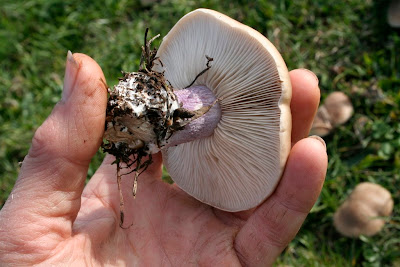
My family and friends regard me as slightly reckless because I do eat wild fungi, but actually I go for those that are easy to identify with a low probability of confusion. These are Field Blewits; very good to eat. They have a lilac-hued foot which is a pretty good clue.
I picked a small fraction of what is out there, but filled most of this bucket. These are for drying and storing so we can use them during the winter.

I often think about our ancestors at times like these. Things that are fun for us - roasting chestnuts, harvesting walnuts, drying mushrooms, even making wine - were probably a matter of considerable importance for them for survival.
After all, a whole winter to get through and no supermarket a few kilometers away.

While they are a natural feature of mushroom growth, there is still uncertainty about exactly how they come about.
They bring with them a rich tapestry folk-lore. From Wiki:
A great deal of folklore surrounds fairy rings. Their names in European languages often allude to supernatural origins; they are known as ronds de sorciers ("sorcerers' rings") in France, and hexenringe ("witches' rings") in German. In German tradition, fairy rings were thought to mark the site of witches' dancing on Walpurgis Night, and Dutch superstition claimed that the circles show where the Devil set his milk churn.
In the Tyrol, folklore attributed fairy rings to the fiery tales of flying dragons; once a dragon had created such a circle, nothing but toadstools could grow there for seven years. European superstitions routinely warned against entering a fairy ring. French tradition reported that fairy rings were guarded by giant bug-eyed toads that cursed those who violated the circles. In other parts of Europe, entering a fairy ring would result in the loss of an eye.
Scandinavian and Celtic traditions claimed that fairy rings are the result of elves or fairies dancing. Such ideas dated to at least the mediæval period; The Middle English term elferingewort ("elf-ring"), meaning "a ring of daisies caused by elves' dancing" dates to the 12th century. In his History of the Goths (1628), Olaus Magnus makes this connection, saying that fairy rings are burned into the ground by the dancing of elves.]
British folklorist Thomas Keightley noted that in Scandinavia in the early 20th century, beliefs persisted that fairy cirlces (elfdans) arose from the dancing of elves. Keightley warned that while entering an elfdans might allow the interloper to see the elves—although this was not guaranteed—it would also put the intruder in thrall to their illusions.
Anyway, I have taken my life into my hands and entered the ring and harvested a goodly few mushrooms.
My family and friends regard me as slightly reckless because I do eat wild fungi, but actually I go for those that are easy to identify with a low probability of confusion. These are Field Blewits; very good to eat. They have a lilac-hued foot which is a pretty good clue.

I picked a small fraction of what is out there, but filled most of this bucket. These are for drying and storing so we can use them during the winter.

I often think about our ancestors at times like these. Things that are fun for us - roasting chestnuts, harvesting walnuts, drying mushrooms, even making wine - were probably a matter of considerable importance for them for survival.
After all, a whole winter to get through and no supermarket a few kilometers away.
Thursday, 30 October 2008
Windowsill Toad
Windowsill Toad. Sounds like it could be a popgroup, or a fairly secure password. But she is actually a toad (well, I don't know, but I feel she is a she):

Windowsill Toad gets her name from the following. Of an evening she climbs up about six of these steps to get to our kitchen window. There the light streams out and attracts insects. And she catches the insects.
She's big, but small compared to the steps. And toads don't jump. They do an exaggerated four legged crawl, Gollum-like.
I sometimes wonder if she is daunted by her task, which feels about as tough as salmon leaping upstream. If she is, she never shows it. You may feel a bit skeptical, but I kid you not, she is a character.
(If you haven't already done so, click the pic and you will be rewarded with a better view of her kindly face).
Sunday, 26 October 2008
Afraid of the free market? Err ... why?
 Afraid of the free market? Personally, I'm afraid of the opposite.
I could leave it at that, but I think the concept of the free market is under a lot of pressure right now, pressure that may be undeserved. And maybe a bad time is a good time to scrutinise this.
And wow, is this a bad time. The world order is in an uncomfortable state ... I for one have considered that my money would actually be better off under the mattress.
You may have seen the posts of various bloggers who are concerned too, and who have picked different facets from the chaos (the greed/need contrast crops up more than once):
like this one from janelle where she highlights the case of a Belgian banker walking out of a disaster with millions of euros in his back pocket
or this one from family affairs who describes how the employees of the failed Lehman Brothers are nevertheless going to get their bonuses paid by Nomura
or this from bush mummy in which her friend Gav, surviving a cancer operation, hits out at inequity: "when I run the world we will swap nurses' and bankers' salaries over..."
You will have seen more of the same. No one, I suspect, has trouble identifying with their sentiments.
But when we look at the financial turmoil of the world right now are we really seeing the results of greed, unbridled capitalism and the failings of free markets?
I'm not so sure. And I (brave, stupid or both) intend to try and make my case here.
 Let's take the case of senior executives leaving failing enterprises with fat severance cheques, lovely index-linked pensions and the like.
What are we seeing? We are seeing civil contracts being honoured. When they were hired, the shareholders represented by the boards were so keen to have these individuals that they gave them very attractive contracts, including severance terms should those contracts be prematurely terminated.
While that might stick in the craw, the fact is the world would be a whole lot worse off if people could, at their whim, fail to honour contracts. This would affect us all - buying and selling houses, making an insurance claim, replacing something under guarantee ...
If the other party could just say, "Sorry things have changed and I now have a poor opinion of you, so I'm not going to pay up" then we would really be in the shit.
Are they greedy? Well, maybe, but that's another matter. Keep the money, give it to charity, that's up to the executives concerned. But honouring contracts is central to civilised life.
How about swapping the salaries of bankers and nurses?
Well, that's an interesting idea and one that has already been tried (I'll come to that). The new state would not last long. Why? Because you would have the worst paid bankers in the world and the best paid nurses in the world. The bankers would go and do other things (the resulting shortage would have their salaries bid up in no time) while the nursing profession would be flooded by incomers (the resulting oversupply would have their salaries crash in no time).
I said it had been tried.
 Time Out is a what's on magazine established by Tony Elliot in 1968, originally as a London Guide. In a fit of egalitarianism everyone was originally paid exactly the same wage. He said (it was his words I borrowed, above) "We had the worst paid journalists in London and the best paid cleaners". The journalists could not wait to leave, while the premises were besieged by frantic wannabe cleaners. It did not last long.
The only alternative is to have the state legislate that your salary shall be X while you, yes you over there, your salary shall be Y.
Thanks, but no thanks. Not a world I want. (It too has already been tried).
The fact is that in a free market people are paid what they are worth, no more and no less. No legislation is needed; it is automatically regulated by supply and demand. Bankers are paid outrageously precisely because (a) not many people have their skills and (b) not many people would like the demanding life style.
But, hey, there's no closed shop. If you want a banker's salary, don't bitch about it, go for it. And see if you like it.
One of my daughters is in the City. She's crammed all her life - GCSEs, slogging to get the A levels results that allowed her to be selected for Cambridge, four years at Cambridge slogging her guts out to get the first she needed to have a chance of getting a training contract by the right kind of corporate law firm, two more years at law college, another training year in the firm (she's at that stage now), nights and weekends mean nothing - the firm gets first call on those hours ... and then, in a year or two, yes, she will be on a six-figure salary. You want all that? Really? I don't.
Result - very little supply, unmet demand, huge salary. It's not rocket science.
Or you can be a nurse. A lot of people want to do it. A lot of people can do it. Therefore it does not pay very well.
So it's not unfairness, or greed, or altruism, or someone manipulating something. Nurses may be saints and bankers may be wankers. But there are, apparently, more saints than wankers. QED.
What about the free market and its failings?
Problem is, markets are seldom free. Consider oil and its yo yo pricing that has been a pain for all of us. The exact opposite to a free market. OPEC is a cartel, sets prices and production quotas and then polices its members to make sure they stick to it.
Another, exact opposite to a free market example: agricultural production, and the obscenity of groaning surpluses in one part of the world and starvation in another. Western governments guarantee prices so there is no market feedback to the producer. In a free market, a grain surplus would lead to falling prices which would have two positive effects - poor countries would benefit from the falling price and farmers would switch to other outputs so that the surplus would self-correct. We hit poor countries again by imposing quotas and otherwise making it difficult for them to sell to us (even though you and I may want their products).
Banks. The exact opposite to a free market. Heavily regulated, unable to set their own interest rates (base rates are set by central banks/governaments), operate on a fractional reserve system which has been passed into law by our governments - which means they actually can't pay us if there is a run on a bank; even in good times!
Don't get me wrong. Many banks have behaved like arses and exposed themselves to enormous risk.
 So do we punish them by allowing them to fail?
Nope. We guarantee deposits and nationalise them to recapitalise them and punish our tax-payers twice. First, by making citizens shareholders (whether they will or whether they won't) of some pretty dodgy enterprises. Second by hitting the value of their savings by printing money to make up the loss of liquidity.
And by the way, where did all this risk arise? Well in the UK trillions are being lost in the housing market. The banks lend money against assets (land and buildings). When people default, the banks have found that they can no longer cover themselves because the asset value has fallen. This is why sub-prime is such a panic. The shortfall is huuuuuuge.
But the housing market has been, yep, the exact opposite to a free market. For years various governments pushed people into house ownership by giving them tax breaks on mortgages, but no tax breaks on rent payments. Then they choked off the supply of land by zoning restrictions. So on the one hand they stimulated demand and on the other hand they restricted supply, leading to decades of house price inflation. And everyone felt rich. Yippee.
Yes. I respect the self-correction of the free market, its flexibility, its responsiveness and the way it aligns the needs of buyers and sellers. There really is nothing like a free market. And what we see around us is nothing like a free market.
OK. That's my rant. I've put my tin hat on. Tell me where I'm wrong.
Monday, 20 October 2008
And the award goes on to ...
The lovely pouting Karen has bestowed an award on me. She is naughty, but I like her. She is also very funny, so as I plough my way through the 31 questions, I shall have to pretend that I have not read hers (or could that be her's; she's a librarian you know, and could be awarding, or deducting, points).
Oh, and I need to remind you that these are to be one-word answers:
Voila!
1. Where is your cell phone? Wozzat?
2. Where is your significant other? Onmyback
3. Your hair color? Grecian
4. Your mother? Dead
5. Your father? Deader
6. Your favorite thing? Whoa!
7. Your dream last night? Freudian
8. Your dream/goal? Breathing
9. The room you're in? Roomy
10. Your hobby? Snapping
11. Your fear? Fear
12. Where do you want to be in 6 years? Here
13. Where were you last night? Abed
14. What you're not? Senile
15. One of your wish-list items? Nurse
16. Where you grew up? Calcutta
17. The last thing you did? Drink
18. What are you wearing? Stuff
19. Your TV? Wavy
20. Your pets? Hairy
21. Your computer? Digital
22. Your mood? Moody
23. Missing someone? Everyone
24. Your car? Carboniferous
25. Something you're not wearing? Contipad
26. Favorite store? BricoDepot
27. Your summer? ish
28. Love someone? Aaaah
29. Your favorite color? Blue
30. When is the last time you laughed? Today
31. Last time you cried? Sob
And since I frightened myself and everyone else with the exponential thingy, I'm not passing this on to anyone else, but you know who you are and I love you all.
Sunday, 19 October 2008
Pressing the grapes, French style
It's the time of year when the vine harvest happens. Naturally the French have a special word for this type of harvest, different from others, and it is "vendange".
We have a small vineyard. In a good year it produces maybe 800-1000 litres of wine. In a bad year, perhaps 250-400. This is not a great issue as it is not commercial and only for our own use. So far I have failed to average a litre a day so there is always a surplus. Which is a handy local currency for returning favours etc.
This has been an awful year. But with an interesting consequence, which I will get to.
This is the raw material; one of our vines on harvest day.
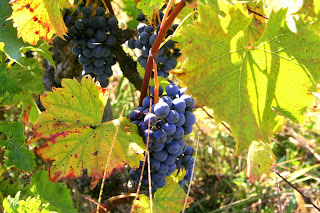
These are some neighbours helping to bring it in. Some we give wine to; others are already wine growers and we reciprocate by helping them harvest in turn.

This is a tombereau, or at least that's how it sounds when they say it. It belongs to a neighbour and I get the loan of it on harvest day. Not only does it hold the grapes you chuck in, but it also has an archimedes screw at the bottom. That means you can pump and slurry the grapes at the same time, and straight into a large barrel called a tonneau, where the primary fermentation takes place.

This is the tonneau (1000 litres capacity), with my bro in law Donald helping after the previous harvest.

Now it happens that this convenience comes at a small price, in that you can't get the last few litres out - the screw won't push them up the pipe and into the tonneau without more stuff behind to help with the pushing as it were.
With the harvest being so poor this year (very late frost and some poor hungry beasts having a bloody good autumn munch) I decided not to use the tombereau.
How, my wife enquired, would we crush the grapes then?
The way our forebears used to, naturally. By treading on them. And I did. Stripped down to my undies, up a small ladder, into the tonneau, and started treading. I have to leave a plastic chair in there so I can get out again!
Now I know the question you are asking. Did I wash my feet? Come on, give me a break, of course I didn't. (They never did in the old days, did they?)
Well the good news is the primary fermentation is coming on just fine. Every two or three days I pop into the tonneau and do my treading. Funny, no one else seems inclined. At the end I emerge, slightly light headed, and with very purple feet.
This evening I sampled my first glass. Still a bit sweet, so more fermenting time needed, but it tastes delicious. Strange, though, I have a feeling that there may not be a stampede for this vintage.
Which is fine by me.
We have a small vineyard. In a good year it produces maybe 800-1000 litres of wine. In a bad year, perhaps 250-400. This is not a great issue as it is not commercial and only for our own use. So far I have failed to average a litre a day so there is always a surplus. Which is a handy local currency for returning favours etc.
This has been an awful year. But with an interesting consequence, which I will get to.
This is the raw material; one of our vines on harvest day.

These are some neighbours helping to bring it in. Some we give wine to; others are already wine growers and we reciprocate by helping them harvest in turn.

This is a tombereau, or at least that's how it sounds when they say it. It belongs to a neighbour and I get the loan of it on harvest day. Not only does it hold the grapes you chuck in, but it also has an archimedes screw at the bottom. That means you can pump and slurry the grapes at the same time, and straight into a large barrel called a tonneau, where the primary fermentation takes place.

This is the tonneau (1000 litres capacity), with my bro in law Donald helping after the previous harvest.

Now it happens that this convenience comes at a small price, in that you can't get the last few litres out - the screw won't push them up the pipe and into the tonneau without more stuff behind to help with the pushing as it were.
With the harvest being so poor this year (very late frost and some poor hungry beasts having a bloody good autumn munch) I decided not to use the tombereau.
How, my wife enquired, would we crush the grapes then?
The way our forebears used to, naturally. By treading on them. And I did. Stripped down to my undies, up a small ladder, into the tonneau, and started treading. I have to leave a plastic chair in there so I can get out again!
Now I know the question you are asking. Did I wash my feet? Come on, give me a break, of course I didn't. (They never did in the old days, did they?)
Well the good news is the primary fermentation is coming on just fine. Every two or three days I pop into the tonneau and do my treading. Funny, no one else seems inclined. At the end I emerge, slightly light headed, and with very purple feet.
This evening I sampled my first glass. Still a bit sweet, so more fermenting time needed, but it tastes delicious. Strange, though, I have a feeling that there may not be a stampede for this vintage.
Which is fine by me.
Tuesday, 7 October 2008
Falling in love
I have been inspired to write on this topic after reading a post by mud who is feeling a bit forlorn about the whole bizz.
 The post attracted a bunch of comments, as you might expect. And quite a few of them were along the lines of "it just happens, and sometimes when you least expect it". That is endorsed by no less than Helen Fielding, author of Bridget Jones' Diary, which was, perhaps, a tad autobiograhical. I read an article by Fielding describing her long wait for the right man, whom she did eventually find, and thinking to herself afterwards "why was I so anxious?"
Anyway, that had me reflecting on love and thinking about how effing useless psychology is when it comes to these important things. We probably learn more from the language around love. For example we have
- "falling in love" which is suggestive of its involuntary and random nature (as when we fall over an obstacle)
- "love struck" much the same
- "love is blind" which is probably a reference to 'blind eye' but in effect says it is hard to predict
- "love sick" which captures its rather overwhelming visceral effects
The first three support the view that love "just happens", can't be hurried along, and can't be engineered.
So what, and perhaps more important, why is love?
We already like to have sex, a handy side effect of which is reproduction, so love doesn't seem to be a necessary condition for anything. But it's here. How come? Well it's a biological truism that we fall in love because those people who did, in the geological past, had better breeding success than those that did not.
Which is interesting.
Perhaps it has to do with what Desmond Morris called "pair bonding". Pair bonding keeps the breeding couple together for all those years it takes to get offspring from infancy to independence. Falling in love initiates the bond, which is then supported and maintained by lashings of sex over the years. Well, quite, but it's true you know. Nothing in the animal kingdom goes in for bonking as we do.
Anyway, none of this gets me nearer to mud and love, so I'll take my chances and move on to what I think it's all about:
attraction -> approach -> reciprocity -> sex -> love (then lots more sex, but we've been there already)
Or for the more romatically inclined, reverse the last two.
First, attraction. Now this is a real mystery. I think we all know that sudden jolt when you find someone attractive; but could we define what it is? Hard for any one of us I suspect but science does provide some clues.
 What makes for a beautiful woman? Apparently an "average" woman. You doubt that? Well take some female faces and crank them through a computer to get the morph average. The result is surprisingly pleasing. This photograph is one I made earlier, morphing just 10 random female faces. It's fun to do, and you can make your own average here. BTW, all this works for male faces too.
Why? Most faces are slightly asymmetrical; the more symmetrical a face is, the more attractive it is judged. Apparently symmetrical faces are advertising hordings that say "I've got good genes, choose me". And the morphing process tends to balance out asymmetries.
Another thing that has men interested is the waist-to-hip ratio. You measure your waist at the narrowest point and your hips at the widest point and get the ratio waist/hips. A ratio of 0.7 seems to be rated universally as the most attractive which is interesting because that is the best predictor of fertility. Apparently Marilyn Monroe had it as does the skinnier Kate Moss.

And so amazingly does the classic Coke bottle; I did some consumer research that showed men find it attractive. Sad buggers.

There is much else; have a look at this article on attraction.
I personally think that attraction is a must. But I have a friend who has been married for 35 years and has grown-up children. He married because their families kind of expected them to. There was really no attraction or love, I don't think.
Next, check that it is reciprocated. It may not be, but that's not the end. I've known people become attracted later, as it were, a kind of catastrophe switch from non-attraction to attraction. I think that sex itself can cause this to happen, but don't do it just because I said so.
If the attraction is mutual you are kind of home and dry. If not, it's uphill work, and in the end unrewarding.
Well, I say home and dry, but that's not quite true. The suggestion is that the more alike the two of you are in background, social standing, education, economics and even genetics, the more likely the relationship is to succeed (boring, but there you go).
Based on my own experience I would say that if it turns out your love is not reciprocated, cut and run no matter how attractive you find them. You may be unhappy now, but boy are you going to be unhappy later if you don't.
Anyway, I think this is why people say well it just comes along, you don't know when, then bam etc etc. The whole attraction thing is very statistical (symmetry and various ratios notwithstanding).
So for two people to get the hots for each other at the same time is just improbable - though completely possible. It just takes time. If you think it is happening, then go for it, and be prepared to make the running.
Postscript: This post was much harder to write than I thought. And a whole lot less useful. But it's late and I'm off to bed.
 The post attracted a bunch of comments, as you might expect. And quite a few of them were along the lines of "it just happens, and sometimes when you least expect it". That is endorsed by no less than Helen Fielding, author of Bridget Jones' Diary, which was, perhaps, a tad autobiograhical. I read an article by Fielding describing her long wait for the right man, whom she did eventually find, and thinking to herself afterwards "why was I so anxious?"
Anyway, that had me reflecting on love and thinking about how effing useless psychology is when it comes to these important things. We probably learn more from the language around love. For example we have
- "falling in love" which is suggestive of its involuntary and random nature (as when we fall over an obstacle)
- "love struck" much the same
- "love is blind" which is probably a reference to 'blind eye' but in effect says it is hard to predict
- "love sick" which captures its rather overwhelming visceral effects
The first three support the view that love "just happens", can't be hurried along, and can't be engineered.
So what, and perhaps more important, why is love?
We already like to have sex, a handy side effect of which is reproduction, so love doesn't seem to be a necessary condition for anything. But it's here. How come? Well it's a biological truism that we fall in love because those people who did, in the geological past, had better breeding success than those that did not.
Which is interesting.
Perhaps it has to do with what Desmond Morris called "pair bonding". Pair bonding keeps the breeding couple together for all those years it takes to get offspring from infancy to independence. Falling in love initiates the bond, which is then supported and maintained by lashings of sex over the years. Well, quite, but it's true you know. Nothing in the animal kingdom goes in for bonking as we do.
Anyway, none of this gets me nearer to mud and love, so I'll take my chances and move on to what I think it's all about:
attraction -> approach -> reciprocity -> sex -> love (then lots more sex, but we've been there already)
Or for the more romatically inclined, reverse the last two.
First, attraction. Now this is a real mystery. I think we all know that sudden jolt when you find someone attractive; but could we define what it is? Hard for any one of us I suspect but science does provide some clues.
 What makes for a beautiful woman? Apparently an "average" woman. You doubt that? Well take some female faces and crank them through a computer to get the morph average. The result is surprisingly pleasing. This photograph is one I made earlier, morphing just 10 random female faces. It's fun to do, and you can make your own average here. BTW, all this works for male faces too.
Why? Most faces are slightly asymmetrical; the more symmetrical a face is, the more attractive it is judged. Apparently symmetrical faces are advertising hordings that say "I've got good genes, choose me". And the morphing process tends to balance out asymmetries.
Another thing that has men interested is the waist-to-hip ratio. You measure your waist at the narrowest point and your hips at the widest point and get the ratio waist/hips. A ratio of 0.7 seems to be rated universally as the most attractive which is interesting because that is the best predictor of fertility. Apparently Marilyn Monroe had it as does the skinnier Kate Moss.
And so amazingly does the classic Coke bottle; I did some consumer research that showed men find it attractive. Sad buggers.

There is much else; have a look at this article on attraction.
I personally think that attraction is a must. But I have a friend who has been married for 35 years and has grown-up children. He married because their families kind of expected them to. There was really no attraction or love, I don't think.
Next, check that it is reciprocated. It may not be, but that's not the end. I've known people become attracted later, as it were, a kind of catastrophe switch from non-attraction to attraction. I think that sex itself can cause this to happen, but don't do it just because I said so.
If the attraction is mutual you are kind of home and dry. If not, it's uphill work, and in the end unrewarding.
Well, I say home and dry, but that's not quite true. The suggestion is that the more alike the two of you are in background, social standing, education, economics and even genetics, the more likely the relationship is to succeed (boring, but there you go).
Based on my own experience I would say that if it turns out your love is not reciprocated, cut and run no matter how attractive you find them. You may be unhappy now, but boy are you going to be unhappy later if you don't.
Anyway, I think this is why people say well it just comes along, you don't know when, then bam etc etc. The whole attraction thing is very statistical (symmetry and various ratios notwithstanding).
So for two people to get the hots for each other at the same time is just improbable - though completely possible. It just takes time. If you think it is happening, then go for it, and be prepared to make the running.
Postscript: This post was much harder to write than I thought. And a whole lot less useful. But it's late and I'm off to bed.
Sunday, 28 September 2008
On holiday with Stanley
So here's a strange associative chain, and it actually did happen as I describe it.
Catching up on a few of my favourite, and not so favourite blogs (yes, I do read some such, driven by a kind of perverse fascination) I reached this conclusion: some very good blogs, by my definition, have no awards, or just a few. Some of those in the other category bristle with awards. Odd.
On this basis I clearly rate my own two blogs since they have, between them, the grand sum of zero awards. On the whole I'm content since I have no great desire to be told that I cheered someone up or made them smile or have become their best mate. (Please don't ruin my day by giving me one now).
Well this reciprocal festooning with awards leads to the first, rather uncharitable, association - mutual masturbation.
Now I have led a chaste life and have never indulged in same-sex mutual masturbation (you will notice that some qualification is needed). On the other hand I did go to a boarding school and was able to observe the impact of pubescence on certain individuals. And, yes, a certain amount of masturbation did take place. If any was of the mutual variety, then I am happy to say that I did not witness it. The solitary was handled quite well however, and before you say it, the pun was unintentional. (A psychologist writes: "puns are never unintentional". To which I respond "just who the eff asked you?").
Back to the point (yes, yes, still unintentional). Rather than masturbation being furtive and embarrassing, a system seems to have evolved such that after 'lights out' those who were thus inclined would engage in masturbatory races, the winner announcing the fact to the assembly. I must stress that this was still rather chaste - no sharing of beds or anything like that, and all under cover of darkness.
Now where was I during all of this? Fortunately I was a year younger than my contemporaries, the consequence of asynchronous educational systems in India and South Africa, and I was not early off the pubescent blocks. Thus I was able to lie in the darkness wondering quite what all the fuss was about.
Which association brings me to my friend Stanley Maloney. Stanley was not intellectually gifted, so he was a year older than most of us, and thus two years older than me. However what God had taken with one hand he had given with the other; Stanley was exceptionally well endowed, the lot topped with enviable quantities of pubic hair. It will not surprise you to learn that he was a frequent winner in those nocturnal races.
Stanley was a good chap to be friends with. He was very strong, and had a quick temper, and for some reason chose to be my protector. He wore a ring which took the form of a skull with two prominent ruby eyes. He told us that it was useful in fist fights. No one rushed to find out if this was true.

So to holiday. Stanley asked if I would like to spend the summer holiday with him. Well, yes, delighted. He lived on the South Coast, a wonderful stretch of South African coastline south of Durban, in a village called Amanzimtoti. My grandmother, who was in charge of me when I was not at school, agreed, and I was sent packing with a fiver.
If someone asked me to describe the holiday in one word, the word would be "formative". The list goes something like this:
- learnt to smoke (unlearnt it as soon as I left, mind)
- had my first french kiss. Boy was that a surprise. My first thought was to say "excuse me, but somehow your tongue has slipped and become lodged in my mouth", but her enthusiasm robbed me of the power of speech. Up to then my model for kissing was provided by Hollywood movies, where the hero and heroine would press their faces together and lips were definitely tightly sealed
- went to my first revivalist meeting, in a big tent. After a Church of England upbringing, this was, if you will pardon the expression, a revelation
- discovered that you could lick the sides of railway trucks transporting molasses and get a sweet taste for free
- was offered a shag in a small tent. It would have been my first - well, for God's sake, I was only 12. She was even younger than I was, poor soul. I fled
- bobbed about in the ocean on a tractor inner tube, in an area notorious for rip tides and shark attacks
- set out folding wooden chairs in the local movie house so we could watch the film for free. I can remember it still, called "Dive, dive, dive", about submarine warfare
- made lots of money, or it felt like it, by collecting discarded bottles and returning them for the deposit money
- taken by Stanley to the ring shop so I too could buy a skull with red eyes
One of my uncles arrived mid-way through the holiday to check up on me (he lived in Durban, so not a long drive). Years later he described his alarm and consternation at the circumstances in which he found me, and the total lack of supervision of our activities. Turns out I was staying with dysfunctional and impoverished white trash.
Ah, the innocence of youth. If the circumstances of the Maloney family were unfortunate, then I was unaware of it. On the contrary, I remember the holiday as blissful, at a time when a little bliss went a long way.
So Stanley, wherever you are, you did cheer me up and you did make me smile, and this is for you.
Sunday, 21 September 2008
The lottery of life - you're a winner
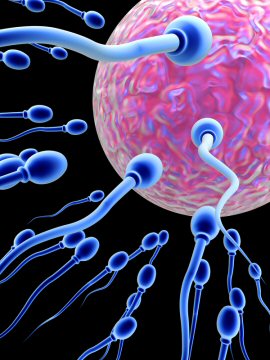
Here is something that I find really strange. Probably the strangest thing I can imagine. See what you think, and if I've got my logic wrong, let me know.
When I was a child I assumed that the three of us (my two sisters and me) were inevitably the children that my parents were going to have. I am the youngest. I often wished I was in fact the oldest. But I always thought it would be "me" whatever the birth order. It just felt inevitable; my parents would have a boy, and the boy would be me.
Of course I now know that isn't the case. If, in my family, a son had been the first born, he would have been the result of a completely different sperm and egg union, and therefore a completely different person complete with his own ego, self awareness and so on.
In fact if "my" particular egg cell and "my" particular sperm cell had not got together, I would never have existed. This I am taking as a given. I base it on evidence such as each of my sisters, each of whom is the result of a different egg and sperm cell, is clearly a person in their own right, and I have no access to their awareness or identity, or vice versa. Had my parents copulated an hour earlier or later even on the same occasion, a different brother or sister would have resulted (bar the absolutely cosmic coincidence of the same sperm cell winning the race anyway).
We get to some startling (at least startling to me) conclusions. Given an egg cell and 300 million sperm cells are present at each act of successful union, any one of 300 million completely different people could have resulted. Each of whom would have had their own ego and awareness.
But wait.
A woman releases something like 400 eggs during her lifetime. A man releases something like 20 thousand million (yup, twenty billion) sperm cells during his life time. So a couple, between them, represent the potential for 8 trillion different people or about as many stars as you would find in 80 galaxies. Every one of whom would have had their own mannerisms, own eye colour, own laugh, own consciousness and own identity, if only "their" union had taken place and therefore they had been born. Of course, the same 8 trillion : 1 are the odds against you or me being born.
So we are extraordinarily lucky, and unbelievably improbable winners in the lottery of life.
But it gets much spookier. If you followed and accept the logic so far, then the same odds applied to your parents. If either of them had not won that lottery too, you wouldn't be here either. Or if they had been born, but teamed up with different significant others, which is actually highly probable, then you wouldn't be here either. Remember, it is a specific pair of cells that gave rise to you; any other pairing doesn't count.
And the logic goes back and back - grandparents, great grandparents and so on.
And so on? Just exactly where do you call a halt? It seems to me that if two rather hairy primate ancestors had not had a quicky 5 million years ago I wouldn't be here either.
Why stop there? I may be able to convince myself that if the DNA in a dividing bacterium a billion years ago had arranged the split differently, I wouldn't be blogging now.
And my last question - where exactly are my poor, unrealised, less lucky, 8 trillion siblings? Who never existed before, had one brief chance of existence and lost, and will never exist in the future.
Sunday, 14 September 2008
Peeking beneath the Diary skirts
I am often asked: why the Diaries and where does the inspiration come from?
Well, to be more accurate, I am never asked, but I thought I'd attempt some kind of answer all the same.
My overarching ambition is to make sense of the universe. I know I won't, but the speculation is fun.
I think there are three big questions.
(1) Why is there anything at all? I don't think existence is inevitable, so why is it all here? And where did it come from? My own guess is that just as +1 and -1 add to nothing, so our universe has its negative mirror image which came into counterexistence just as ours did, so as to balance the books. And I suspect will both collapse back to zero together.
(2) Why is there consciousness? It is weird and not inevitable either, and not necessary for complicated life. For example, I don't really think that wasps are conscious, but they have pretty complicated lives. Nor is it confined to humans as anyone who has made eye contact with an animal will understand.
(3) Is there a God? I can answer this one at once. Of course not, at least not the God of the bible. If we can think it up, then it almost certainly does not exist. Haldane was right. The universe is not stranger than we know, it's stranger than we can know. Ergo, any God we can conceive of is plainly wrong.
I guess this is where the Diaries come from. What kind of entity might run the universe?
Well, problem the first is one that it is not of the universe. He (we'll stay with the masculine thingy) may have created the universe and everything in it, but (by all accounts) did not create himself at the same time. So he was "somewhere else" at the time the universe came into being. And when I say, came into being, I'm taking space and time too, not just matter. Now if he's not of this universe, that is, outside our spatial dimensions, and outside of our time, he's going to have a lot of problems interacting with it.
Let's get this straight; we're talking physics here. When the Red Sea parts, there's an awful lot of pressure on water molecules trying to establish their level again. If they don't then there is a counter force. Not a cosmic "Don't you dare, 'cos I say so". No, it takes the expenditure of energy, in this universe, to hold water back.
Then there's the whole problem of the consequences of intervention. I mean, you can pray that plate tectonics go on hold for a while, so you and your family don't get drowned in a tsunami. But think about the buckling of the Earth's mantle that happens elsewhere as a result, and the innocents who get killed there, so you do not.
No, there's not a sodding thing that God can do that won't have horrendous counterconsequences.
Which means that prayer must go unanswered (which, I suspect, is pretty well the experience of all of us).
Note that none of this is a disproof of God. He may well exist. I don't think so, but I'm not anti-religious. My father-in-law is a clergyman, so there. In fact, if you are determined to believe in an all-powerful entity you can't be proved wrong. The world and universe could easily have been created in the last millisecond, and we with all our memories with it (and the fossil record too etc etc).
But my goodness, why would anyone bother? And that is a good question. So we could praise Him? I think He should get a life.
The thing that always puzzles me is why people think that God is good. We might jolly well hope so, but where is the evidence? Take nature. I'm afraid the "All things bright and beautiful ..." model just doesn't hold water. The Victorian view of "Nature red in tooth and claw" has it about right. Fact is, it's pretty horrid. There is not a prey animal that dies of old age. Sooner or later it gets torn apart. There is not a predator that doesn't die of injury or starvation in it's turn.
Creationism? Intelligent design? Give me a break. For every intelligently designed butterfly there is an intelligently designed tape worm.
It is the appearance of design and order that has folk thinking about designers and, well, benign and wise fathers. Alas most people don't grasp how, with enough time, very improbable things can not only happen, but become inevitable.
Remember that thing about monkeys, typewriters, and the complete works of Shakespeare? Well, I've done the calculation. If we treat upper and lower case letters as different, we have 52 of those, plus some punctuation, let's call it 60 things for convenience.
OK, so how unlikely is it, selecting letters and punctuation at random, to come up with the four characters "The ". Well, the number is 60 raised to the power 4, which is just a whisker under 13 million to one or about the same as winning the UK National Lottery. Extend this to a five letter word plus space like "Hello " and the odds become 46 billion to one. So you can see that the complete works of Shakespeare are not going to pop out of the monkey factory overnight.
But factor in infinity. Prepare for strange things. For given infinity, not only has the complete works of Shakespeare actually been generated this way, it has been generated, wait for it, an infinite number of times.
As I understand it the universe is not actually infinite, but who knows? However, it has been around for a long time, and will be around for a long time yet. And that means that strange things can happen. For example, the dinosaurs vanished about 65 million years ago. If you had been around since then (not a long time in Earth terms) and bought a lottery ticket a week, as a lot of folk do, you would have won the lottery about 200 times by now.
Of course evolution is not random, though I'll skip the logic for that now. However, it is fed by small random mutations. That is where the argument about odds and time becomes important.
Anyway, after enough rambling to bore even me, my conclusions are these:
- We may have been created by God, but the chances are he is "hands off" and has to be.
- He is not hugely preoccupied by the thought of being praised by a bunch of naked apes who do, actually, not look at all like him.
- He is not hugely preoccupied by sin or virtue.
- Having created the universe and the laws that drive it, he just kind of lets it go, and maybe has a look now and then when bored out of his skull.
- He is more than a little paranoid, and often wonders about where the f*ck he comes from and wonders how many layers of deity exist above him and in what kind of infinite regress.
I'll leave you with this, which I think is fun, and should put us in our place:
From William Goodhart's play Generation:
The Soul of Man,
Despite his pride,
Is rather odd,
A toy balloon
Blown up by God,
Or, strictly speaking,
The air inside,
And that is leaking.
Monday, 8 September 2008
Supper
I once had a book called "Food for Free". It is somewhere in our boxes, and I hope it will surface again one day. It lists things you can find and eat such as watercress, mushrooms and nuts. For free. An idea that I find attractive to this day.
You have to be careful though. For example you can get liver fluke from watercress if the stream flows through fields where sheep graze. And mushrooms scare a lot of people, for very good reasons. Some of them are absolutely lethal.
Here in France you can, in principle, take a fungus to your local pharmacy, and they will identify it for you and tell you if it is safe to eat. In principle. The last time I tried this the pharmacist turned to the only other customer in the shop and asked "Qu'en pensez-vous?" (What do you think?). Slightly defeated the purpose I decided, made my excuses and left.
That doesn't mean that I don't find and eat wild mushrooms. It just means that (a) I consult one (or more) of my four mushroom books and (b) I tend to go for things that are unmistakable.
Which leads me on to supper.
I was walking through the local woods when I found a beefsteak fungus. It is a bracket fungus and it looks like this:

It is called a beefsteak fungus because it looks remarkably like meat. When you cut it it even bleeds a bit. All this is rather disconcerting for a vegetarian, but anyway. I took one third of the fungus, thinking that I would in this manner not piss the fungus god too much, but on my way home I realised that, since the fungus is a parasite on the tree, I had probably displeased the tree god as well. Oh dear.
The photograph above is one I found on Google Images because I hadn't taken my camera with me. However the following is of the actual fungus and you can see (have a click) just how like meat it is.

That's a proper dinner plate, so you can see these things are big. I sliced it up ready to fry:

And fried it:

Delicious!
You will remember I like to go for fungi that are unmistakable? Well the clincher for beefsteak fungus is that it has a slight taste of lemon on the finish. Taste that, and you are home and dry.
In passing, another fungus that comes into the 'unmistakable' category is the unfortunately named "Trompette de la Mort" or Trumpet of Death. It is brown/grey/black and trumpet-shaped, so you can see the point. Still, I often feel that the poor thing could do with a better agent, since it too is delicious. Photo when Autumn arrives.
You have to be careful though. For example you can get liver fluke from watercress if the stream flows through fields where sheep graze. And mushrooms scare a lot of people, for very good reasons. Some of them are absolutely lethal.
Here in France you can, in principle, take a fungus to your local pharmacy, and they will identify it for you and tell you if it is safe to eat. In principle. The last time I tried this the pharmacist turned to the only other customer in the shop and asked "Qu'en pensez-vous?" (What do you think?). Slightly defeated the purpose I decided, made my excuses and left.
That doesn't mean that I don't find and eat wild mushrooms. It just means that (a) I consult one (or more) of my four mushroom books and (b) I tend to go for things that are unmistakable.
Which leads me on to supper.
I was walking through the local woods when I found a beefsteak fungus. It is a bracket fungus and it looks like this:
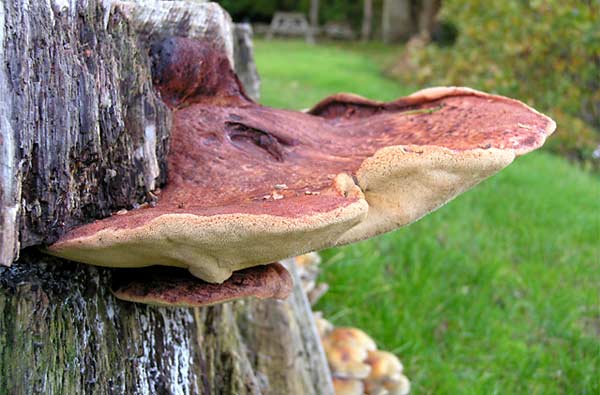
It is called a beefsteak fungus because it looks remarkably like meat. When you cut it it even bleeds a bit. All this is rather disconcerting for a vegetarian, but anyway. I took one third of the fungus, thinking that I would in this manner not piss the fungus god too much, but on my way home I realised that, since the fungus is a parasite on the tree, I had probably displeased the tree god as well. Oh dear.
The photograph above is one I found on Google Images because I hadn't taken my camera with me. However the following is of the actual fungus and you can see (have a click) just how like meat it is.

That's a proper dinner plate, so you can see these things are big. I sliced it up ready to fry:

And fried it:

Delicious!
You will remember I like to go for fungi that are unmistakable? Well the clincher for beefsteak fungus is that it has a slight taste of lemon on the finish. Taste that, and you are home and dry.
In passing, another fungus that comes into the 'unmistakable' category is the unfortunately named "Trompette de la Mort" or Trumpet of Death. It is brown/grey/black and trumpet-shaped, so you can see the point. Still, I often feel that the poor thing could do with a better agent, since it too is delicious. Photo when Autumn arrives.
Subscribe to:
Posts (Atom)